Showing posts with label combinametrics. Show all posts

Saturday, August 18, 2018

#Combinametrics, #Probability - The chances of having the same birthday...

Question

How many people need to be in the same room for there to be a 50% chance that two of those people will have the same birthday?

Answer

23 people

Analysis

When working out this kind of problem, it's all in the approach. For this problem, let's work up to a method of doing it.

One of to do it would be to find the number directly - as in calculating the probability "from the ground up". The other way to do it is to see what the probability is of not having the situation and subtracting that from 1 (1 being the sum of all probabilities possible). It's this "subtracting" approach we'll use. To see how, let's follow smaller groups of people and work up to bigger ones.

Let's say we have 1 person in a room (person A). A can have a birthday that can be any one of 365 days (we'll ignore leap days). We can express this as


If we put a second person into the room (person B), B too can have any one of 365 days as their birthday. If it's not the same day as A, then it can be any one of 364 days:



probability that it's different.

Which also means that there is a
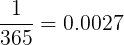
 

probability it's the same.

If we put a third person into the room (person C), C can also have any of the 365 days as their birthday. For A, B, and C to all have different birthdays, we can say:


probability that they are all different, which means there's a 0.0083 probability (1 - 0.9917) one of them is the same.

And so on. Note that we end up with a numerator that is a permutation and a denominator that is 365 taken to the power of the number of people in the room. Therefore, we can generalize the calculation as:


And now we want to find where our expression is 50%:


This is a very gnarly problem to work with algebra - it'd be better to use a graphing technique or a spreadsheet to work through values of n. And so I worked it using a spreadsheet and found that at 23 people, there's roughly a 50% probability of at least 1 shared birthday.

As a side note, at 57 people, there is a better than 99% probability of at least 1 shared birthday.

The spreadsheet is here:
https://docs.google.com/spreadsheets/d/1XPWcgzaXS5zcXOF5M0VzofFMxJGtsFwlrrX_3ybPxtE/edit?usp=sharing

~~~~~

Questions and comments always welcome!


Saturday, July 28, 2018

#Admin - A new blog, a new beginning, a new conversation on math-y topics!

Hello one and all and welcome to Math Fact-orials!

In this post, the first of this blog, I'll talk quickly about me, this blog, what I hope to achieve, and all that.

About me

I love thinking and learning and sharing what I'm thinking and learning. Most recently, I was a Hero and Featured Answer Reviewer (Algebra, PreAlgebra, English Grammar) with www.Socratic.org, with (at the time of this writing, with roughly 2 weeks of life left in Socratic):

- over 890,000 views,
- 2400 answers, and
- 700 edits of existing answers.

But since that website is currently scheduled to be shuttered mid-August 2018, I've decided to start my own Question and Answer site (i.e. this blog) that will focus on things I find important/interesting/fun/etc.

Some more things about me:

- Formerly a Certified Public Accountant (in the USA) and a Chartered Accountant (in Canada)
- Holder of a Life Coaching certificate
- Spent a few years in the US Navy as a Supply Corps officer

About the blog

While I don't want to set anything in stone (this is a living blog after all, so it will morph and change as I do), there are a couple of areas I'll tend to focus on at the start: Combinametrics (or the number of ways of doing/arranging/organizing things) and something I'll call Life Math - this will encompass things like Business Math, Budgeting, Investing, Accounting, Financing, and all those non-sexy math topics that academics tend to shun. Life Math, by its very nature, is a bit more "squishy" than academic math - there typically are more "squishy" answers than in academic math. For instance, is a 10% discount on a shirt a good discount? It might be, but then again it might not be - it's up to the reader to decide. But in these kinds of questions and answers, I'll do my best to lay out some things to think about.

I intend to right about how to approach a problem as the first part of any blog post, and then to have an "Answer Key" below, which will show the various answers with changes in the starting facts. For instance, if a shirt that costs $30 has a 10% discount (with a final cost to the customer of $27 before sales tax), the same process will work if the shirt is $40 and there's a 20% discount (with a final cost of $32 before sales tax).

Questions are very welcome!!!

If you have math questions, please do ask! Post a comment (I approve all comments) and I'll be sure to respond and write on the blog in response. No names/specific locations will be used and so don't worry about anonymity!

And I think that just about does it - so Welcome! and I hope to hear from you.

Parz

Update, 22 Aug 2018

Through editing and updating the organization of the blog, I'm hoping it'll be more useful (and easier to find the information you are interested in!). Links, labels, and subjects are all being edited, reworked, and otherwise made better. Get ready for Math Fact-orials 2.0! (or maybe just 2!... - factorials and decimal points don't get along very well...)

Popular Posts